

Could Your PPE Be Increasing Workers’ Heat Risk?
Personal protective equipment can be essential, but it can also trap heat, restrict evaporation and increase physical effort. Sysco Environmental explains how UK employers can control both hazards without compromising either protection or productivity.
In Brief
- PPE is the final layer in the hierarchy of control, not a substitute for eliminating or reducing the underlying hazard.
- Heat risk depends on air temperature, radiant heat, humidity, air movement, workload, duration and the clothing ensemble—not temperature alone.
- A suitable and sufficient assessment should consider the actual task, wearer, work pattern and PPE combination.
- Engineering controls, planned recovery, acclimatisation, hydration and effective supervision should work together.
- Confusion, collapse, loss of coordination or altered behaviour in a hot worker is an emergency: stop work, cool the person and obtain medical help.
Protection Can Create a Second Hazard
The body controls temperature mainly by increasing blood flow to the skin and evaporating sweat. Impermeable and semi-permeable clothing limits evaporation. Multiple layers add insulation, while tight seals and full-body coverage reduce air movement. The weight and resistance of the ensemble make movement harder, increasing metabolic heat precisely when the body has fewer ways to release it. Respirators may also add breathing resistance and make a demanding job feel more strenuous.
This is why heat stress can arise in apparently moderate conditions. A worker carrying out heavy manual activity in encapsulating clothing may be at greater risk than someone doing light work at a higher air temperature. HSE identifies six relevant factors: air temperature, radiant temperature, air speed, humidity, clothing or PPE insulation, and work rate. A thermometer reading on its own cannot represent the complete exposure.
The UK Legal Position
Under the Health and Safety at Work etc. Act 1974, employers must, so far as is reasonably practicable, protect employees’ health, safety and welfare. The Management of Health and Safety at Work Regulations 1999 require a suitable and sufficient assessment of risks and effective preventive arrangements. The Workplace (Health, Safety and Welfare) Regulations 1992 require a reasonable indoor working temperature, but UK law does not set a universal maximum temperature. The absence of a numerical ceiling does not remove the duty to control foreseeable heat risk.
The Personal Protective Equipment at Work Regulations 1992, as amended in 2022, require suitable PPE where risk remains after other controls. Suitability includes the nature of the risk, working conditions, ergonomics, the wearer’s health and correct fit. Equipment used together must remain compatible. Employers must provide information, instruction and training, and maintain, store and replace PPE appropriately. The amended duties extend to limb (b) workers as well as employees.
These requirements should be read as one control system. It is not enough to say that PPE was issued. An employer must consider whether the task can be eliminated, enclosed, automated or otherwise controlled; whether the selected ensemble adds a heat hazard; and how the residual combined risk will be managed.
Assess the Real Work, Not a Generic Job Title
A useful assessment begins at task level. Observe the work in representative conditions and record the heat sources, duration, pace, postures, access restrictions and opportunities for recovery. Identify whether the worker is in sunlight, near furnaces, steam lines or hot product, and whether air movement helps or merely circulates hotter air. Humidity matters because it reduces the effectiveness of sweating.
Document every item worn, including ordinary clothing beneath PPE. Consider whether garments are vapour-permeable, whether hoods and gloves close escape routes for heat, and whether respiratory equipment or harnesses add effort. Consult the manufacturer about thermal characteristics, limitations and compatible cooling arrangements. Where different combinations are worn during a shift, assess each meaningful combination.
Work rate is equally important. Walking, climbing, shovelling, lifting and working against tool resistance generate metabolic heat. A short, intense intervention may produce a rapid thermal load, while repetitive moderate work can accumulate strain over a long period. Include foreseeable delays, such as decontamination or waiting to leave a controlled area, because exposure does not end when the productive task stops.
Individual susceptibility varies. New starters, people returning after absence and workers who have not recently worked in heat may not be acclimatised. Fitness, pregnancy, some health conditions and prescribed medicines may affect tolerance. This does not justify excluding people on assumptions. Use occupational-health advice, protect confidentiality and make reasonable adjustments where required. Encourage workers to report concerns without fear that doing so will be treated as weakness.
HSE’s heat-stress checklist is a practical screening tool. Complex or high-risk work may require a competent occupational hygienist to undertake a quantitative assessment using an appropriate index and measurements. Wet Bulb Globe Temperature can be useful, but its interpretation must reflect workload, clothing adjustments and the limitations of the method. A single number should never replace observation and professional judgement.
Apply the Hierarchy of Control
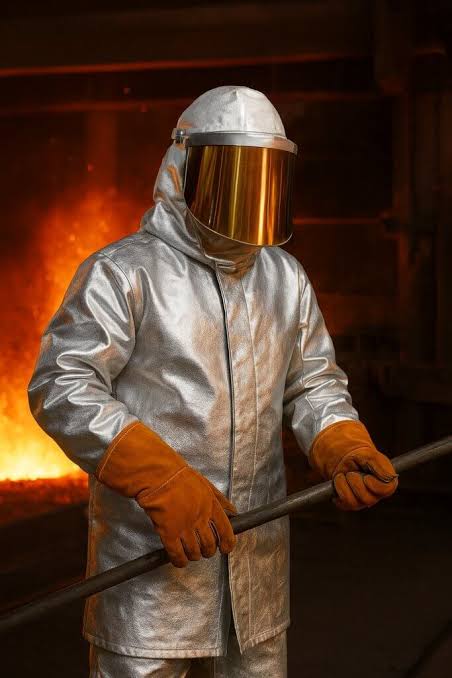
Where PPE remains necessary, select the least thermally burdensome equipment that provides the required protection. “Lighter” does not automatically mean suitable, and comfort must not weaken chemical breakthrough resistance, flame performance or respiratory protection. Trial equipment with representative users and tasks. Check movement, visibility, communication, compatibility and doffing. Re-evaluate the selection when materials, processes, temperatures or suppliers change.
Powered or supplied-air respiratory equipment may reduce some burdens in suitable applications, although it introduces other constraints and must be selected through the respiratory-protection assessment. Cooling vests or garments can help in some environments, but they are supplementary controls. Their cooling period, added weight, recharge arrangements, hygiene, compatibility and potential to mask rising strain must be understood.
Design Work and Recovery Together
Work–recovery arrangements should reflect measured conditions, workload and PPE, not a fixed summer timetable. Define triggers for increasing recovery or stopping work, and give the person in charge authority to use them. Conditions can change quickly when cloud clears, ventilation fails or production demand increases. Review the plan during the shift.
Recovery begins only after the worker reaches a safe area and can remove PPE without spreading contamination or encountering the original hazard. Plan doffing, decontamination and travel time. Provide enough clean, serviceable equipment so damp PPE can dry or be replaced. HSE advises removing PPE as soon as it is no longer required, while emphasising that workers must not loosen or undo it within the hazardous area simply to obtain relief.
Provide accessible drinking water and regular opportunities to drink. Hydration supports temperature regulation but does not make excessive exposure safe. Do not rely on thirst, urine colour or prescribed drinking quantities as the sole control. Excessive fluid intake can itself be harmful, and workers with medical restrictions may need individual advice. For prolonged heavy sweating, occupational-health input can inform appropriate arrangements.
Acclimatisation, Information and Supervision
Acclimatisation is the gradual adaptation that occurs through repeated controlled exposure. It can be lost after time away. Build a progressive programme for new workers and those returning after illness, holiday or cooler duties. There is no single schedule suitable for every workplace: the rate should reflect the environment, task, PPE, individual response and competent advice. Never use acclimatisation to justify exposure that could reasonably be reduced.
Training should explain why PPE increases thermal strain, how the controls work, what symptoms to report and how to summon help. Workers need to understand that poor concentration, irritability, clumsiness and unusual decisions may be early warning signs. Supervisors should recognise changes from a person’s normal behaviour and intervene promptly. A buddy arrangement can be valuable during high-risk or isolated work, but it must have clear checking intervals and escalation instructions.
Avoid a culture in which completing the job is praised more than stopping safely. Workers should know that they may pause and report symptoms. Supervisors should record heat-related complaints, near misses, unexpected PPE removal and productivity changes; these may reveal that the planned controls are failing.
Recognise and Respond to Heat Illness
Confusion, altered consciousness, collapse, seizure, severe loss of coordination or very hot skin can indicate a life-threatening emergency. Call 999, begin rapid cooling using methods appropriate to the setting, and do not leave the person alone. Do not delay urgent action while attempting to obtain a perfect temperature measurement. Site arrangements should state who calls emergency services, how responders reach the casualty and how contaminated PPE will be managed.
Review every suspected case. Examine conditions, work rate, staffing, PPE, recovery, hydration, acclimatisation and supervision rather than attributing the event to individual resilience. Preserve monitoring data and speak with those involved. Findings should lead to changes in the assessment and operating plan.
Building a Defensible Control Programme
Sysco Environmental can support organisations with workplace heat-stress assessment, occupational-hygiene monitoring and practical control advice. The objective is not to choose between protection from the original hazard and protection from heat. It is to design work so both risks are controlled together, and to verify that the arrangements remain effective where the work actually happens.