

What Is That Chemical Label Really Telling Your Workers?
Chemical labels provide an immediate warning, but they are not a complete risk assessment. Sysco Environmental explains the current Great Britain CLP elements, supplier and user responsibilities, and how labels should support COSHH control in practice.
In Brief
- In Great Britain, suppliers classify, label and package hazardous substances and mixtures under retained GB CLP arrangements; Northern Ireland follows a distinct market regime.
- A GB CLP label may include a product identifier, supplier details, pictograms, signal word, hazard statements, precautionary statements and supplementary information.
- The label and safety data sheet communicate intrinsic hazard; the COSHH assessment determines risk from the actual task and exposure.
- Decanted workplace containers still need clear identification and risk communication under the employer’s control system.
- Missing, damaged or inconsistent labels should trigger quarantine and supplier enquiry rather than guesswork.
A Label Is the Start of the Control Conversation
Hazard labels allow workers to recognise that a product may burn, corrode, poison, sensitise or harm the environment. Standardised pictograms and statements help information travel through the supply chain. However, a label cannot describe every task, concentration, quantity, temperature or exposure route at a particular workplace.
Two employers can buy the same product yet create different risks. One uses a few millilitres in an enclosed analyser; another sprays litres in a poorly ventilated room. The classification remains the same, but the exposure and required controls differ.
Employers should therefore link three layers: the supplier label for rapid hazard communication, the safety data sheet for more detail, and a task-specific assessment under the Control of Substances Hazardous to Health Regulations 2002 (COSHH). None replaces the others.
GB CLP and Territorial Scope
The Great Britain Classification, Labelling and Packaging regime—GB CLP—applies in England, Scotland and Wales. It is based on the retained version of Regulation (EC) No 1272/2008 as amended for Great Britain. HSE is the lead GB CLP agency.
Northern Ireland remains subject to separate arrangements linked to EU CLP for relevant goods. Businesses supplying across UK markets should verify which regime, responsible entity and label requirements apply. A label lawful for one market should not be assumed correct for another.
Manufacturers and importers generally classify substances and mixtures they place on the GB market. Downstream users and distributors also have duties appropriate to their role. Classification compares available hazard information against regulatory criteria. It describes inherent properties, not whether a particular use is adequately controlled.
GB CLP operates alongside UK REACH, product-specific regimes and workplace law. Biocides, pesticides, cosmetics, transport and other sectors may have additional requirements. Employers should identify the complete applicable framework rather than treating a generic label checklist as universal.
The Core Label Elements
The precise content depends on classification, package and supply circumstances, but the following elements commonly appear.
Product identifier
The identifier connects the container with the substance or mixture and its safety data sheet. It may be a trade name plus chemical identities required by the rules. Employers should ensure purchasing records, inventories, labels and safety data sheets refer to the same product and formulation.
Supplier details
The label gives the name, address and telephone number of the GB-based supplier or suppliers required by the regime. These details provide a route for further information. They are not necessarily the number to use for every emergency, so site arrangements should identify appropriate emergency contacts separately.
Hazard pictograms
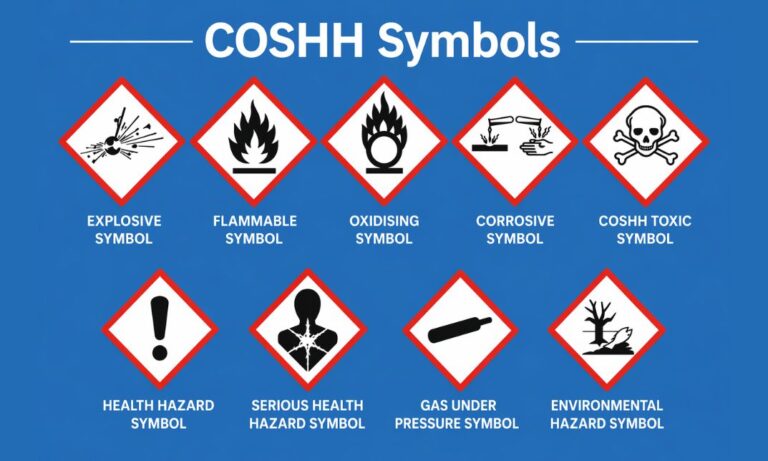
GB CLP pictograms are black symbols on a white background within a red diamond. Symbols cover exploding hazards, flammability, oxidising properties, gases under pressure, corrosion, acute toxicity, serious longer-term health hazards, less severe health effects and environmental hazards.
A pictogram is not a full description. The exclamation mark, for example, can represent several classifications. Read it with the hazard statements. Absence of a particular symbol does not prove that a product is harmless or outside COSHH.
Signal word
“Danger” identifies more severe hazard categories and “Warning” less severe categories under the allocation rules. Where a signal word is required, only the applicable one appears. It does not rank unrelated products or replace the classification detail.
Hazard statements
Hazard statements describe the nature and, where relevant, degree of hazard, such as severe eye damage or flammability. Their standard wording is tied to classification. Read every statement: one prominent pictogram can draw attention away from chronic health or environmental hazards.
Precautionary statements
Precautionary statements describe recommended prevention, response, storage and disposal measures. Label space and selection rules mean not every conceivable precaution appears. Employers must not treat them as a complete safe system of work.
Supplementary information
Additional EUH or other required statements may communicate hazards not fully expressed through the core set. Product-specific authorisation information and directions may also apply. Marketing text must not contradict classification or use misleading claims such as “non-toxic” where prohibited.
Labels, Safety Data Sheets and COSHH
A safety data sheet (SDS) gives structured information on hazards, composition, first aid, firefighting, accidental release, handling, exposure controls and other matters. It supports assessment but may cover multiple uses or broad control options. Check the revision date and obtain an updated sheet when formulations or classification change.
The COSHH assessment asks what actually happens. Identify quantity, concentration, physical form, temperature, release mechanism, route, frequency, duration and people affected. Include substances generated by work, such as welding fume or process dust, which may have no supplier label.
Apply the hierarchy: eliminate or substitute; enclose or automate; use local exhaust ventilation and other engineering controls; establish safe systems; and use suitable PPE or RPE for residual risk. A label instruction to wear gloves does not establish which glove material or breakthrough time suits the task.
Where a workplace exposure limit applies, consult the current EH40 and assess exposure properly. A product label does not state whether the worker’s inhalation exposure meets the limit or whether control is as low as reasonably practicable for a carcinogen, mutagen or asthmagen.
Decanting and Workplace Containers
Chemicals are often transferred into dosing bottles, wash containers or process vessels. Unlabelled secondary containers create obvious risk: the substance may be misused, mixed incompatibly or handled incorrectly during a spill.
Workplace labelling should identify the contents and communicate necessary hazards and precautions in a durable, legible form. The exact approach depends on supply status, container, process and assessment. Do not copy a small section of the supplier label while omitting information that workers need.
Avoid transferring hazardous chemicals into food or drink containers. Standardise workplace labels and prohibit handwritten abbreviations known only to one shift. Where pipework or fixed plant uses alternative identification systems, train workers and ensure maintenance and emergency teams can interpret them.
Temporary use does not justify confusion. If a substance remains under the direct control of the person who transferred it for immediate use, local arrangements may differ, but the safe system should define this narrowly. Containers left for another person or shift require identification.
Check Labels at Receipt and During Use
Goods-in checks should confirm product identity, package integrity, readable label, expected supplier and availability of the correct SDS. Quarantine leaking, damaged, unlabelled or unexpected products. Do not smell or test an unknown chemical to identify it.
Inspect labels during storage. Chemicals, sunlight, abrasion and condensation can make them unreadable. Replacement labels must reproduce accurate current information; downloading an unrelated online label can introduce a different formulation or jurisdiction.
Compare the label and SDS where information appears inconsistent. Contact the supplier and document resolution. Check stock following a regulatory or formulation update and follow legitimate transitional provisions rather than relabelling blindly.
Train Workers to Use Information
Training should connect symbols and statements to actual tasks. Workers need to find the product identifier, recognise severe hazards, locate first-aid and spill information, and know where the full assessment and SDS are available. Use practical examples from the workplace.
Information must be understandable. GB labels are in English, while supplementary translations or training may help a multilingual workforce. Translations should not obscure or contradict the official information. Literacy and visual impairment should be considered in the communication plan.
Supervisors should challenge missing labels, inappropriate decanting and reliance on PPE. Emergency exercises can test whether teams locate the right SDS and respond to the substance actually involved.
Review the Chemical-Information System
Maintain a current inventory linking product, location, quantity, SDS revision and COSHH assessment. Remove obsolete duplicates and confirm whether products remain in use. Review after substitution, formulation change, new supplier, classification update, incident or worker concern.
Sysco Environmental can support COSHH assessment and exposure evaluation where label information must be translated into workplace controls. The value is not in repeating hazard statements, but in determining how exposure occurs and whether controls work.
A compliant supplier label communicates hazard at a glance. Safe use depends on the employer carrying that information through procurement, assessment, decanting, training, engineering control and review.
Periodic audits should sample containers across stores, production, laboratories, maintenance areas and waste points. Record recurring failures by source and correct the underlying purchasing, decanting or supervision process rather than replacing individual labels repeatedly.