

HSE Engineered Stone Enforcement 2026: First Prohibition Notices and What They Mean for Silica Dust Compliance
HSE has moved from guidance to enforcement — issuing its first-ever prohibition notices over engineered stone and, days later, its first-ever action against an occupational health provider for substandard health surveillance. Here's what the case files reveal, and what they mean beyond construction.

Article overview
This article builds on our earlier guide, Silica Dust Exposure in 2026: What Every Construction Employer Needs to Know, which covered the fundamentals of respirable crystalline silica (RCS), its health effects, and the hierarchy of control. Since that piece was published, HSE has moved from guidance to active enforcement, and the detail in these cases changes what "good compliance" needs to look like in practice.
Within a fortnight this summer, HSE published two enforcement stories that any employer managing silica, dust, or health surveillance obligations should read in full. On 25 June 2026, HSE confirmed it had issued its first-ever prohibition notices against four businesses working with engineered stone, ordering them to stop work immediately over uncontrolled RCS exposure. On 3 July, HSE went further still, taking its first-ever enforcement action against an occupational health service provider - not the employer, the provider itself - after finding that health surveillance was being delivered by staff who were "inadequately trained, unqualified, and unsupervised."
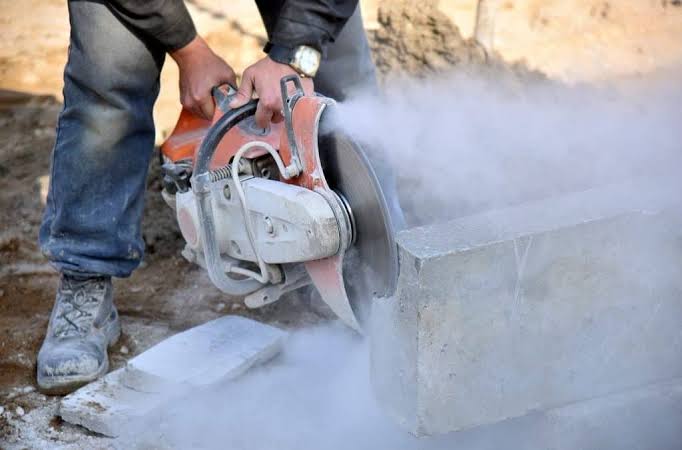
Where our earlier article set out the general risks and controls, these two cases show exactly where real businesses are still falling short, and they introduce a compliance dimension - the quality of health surveillance itself - that hadn't previously been tested through enforcement.
What the engineered stone notices actually found
Engineered stone is a quartz-based composite widely used in kitchen worktops, cladding, and washroom surfaces, and it has become the sharpest edge of the UK's silica problem. HSE's own research found that dry fabrication methods - cutting, grinding, and polishing without water suppression - generate RCS exposure five to ten times higher than wet processing. That evidence underpins HSE's first-ever dedicated COSHH guidance sheet for the sector, published alongside a commitment to run more than 1,000 inspection visits through the 2026/27 period.
The four prohibition notices served by the end of May were not issued for dry-cutting alone. HSE's investigations also identified failures in health surveillance, respiratory protective equipment (RPE), local exhaust ventilation (LEV), and machinery guarding at the affected sites - confirmation that inspectors are now assessing the whole control system, not a single measure in isolation. Two details from the case are worth noting for anyone outside construction who assumes this doesn't apply to them: HSE's guidance also rules out dry-cutting, grinding, and polishing unless a business can demonstrate an equally effective alternative control, and manufacturers, suppliers, and importers carry a separate legal duty under Section 6 of the Health and Safety at Work etc. Act 1974 to provide adequate information about the risks of the materials they supply - including pointing customers toward lower-silica engineered stone products, which HSE's research indicates perform to the same quality standard.
Why the occupational health provider case matters more than it first appears
The 3 July action is, in some respects, the more consequential story. HSE found the provider's health surveillance arrangements were "fundamentally unsuitable" - no competent clinical oversight, no quality assurance process, and no procedure for escalating adverse findings or reviewing workplace controls when a problem was flagged. As HSE Occupational Health Inspector Julie Wood put it: "When [health surveillance] is carried out poorly, employers are given false assurance and workers are left unknowingly at risk." In this case, the workers affected were exposed to wood dust and noise, and the conditions going undetected were occupational asthma, dermatitis, and noise-induced hearing loss - a reminder that this issue reaches well past silica into any COSHH- or noise-regulated workplace.
This is genuinely new ground. Health surveillance is a statutory requirement under both the COSHH Regulations 2002 and the Control of Noise at Work Regulations 2005, and until this case, enforcement attention had focused almost entirely on employers rather than the providers delivering the surveillance on their behalf. That has now changed, and it means the competence of your occupational health provider is itself now a live compliance issue.

A practical checklist this case makes newly relevant
Employers reviewing their arrangements in light of this case should be able to answer four questions with confidence, none of which were addressed in our earlier introductory guide. Is the surveillance being delivered by clinicians who hold recognised occupational health qualifications, rather than generalist practitioners working outside their competence? Is there a documented quality assurance process reviewing surveillance outcomes, not just a certificate at the end of an appointment? Is there a clear, working procedure for escalating an adverse finding back to the employer so controls can be reviewed before harm occurs? And can the provider evidence clinical governance - named responsible clinicians, audit trails, and a route for challenge - rather than relying on your trust alone?
Alongside this, HSE's enforcement notices are published roughly five weeks after being served to allow for appeals and quality assurance, so the four prohibition notices reported in June reflect inspections carried out earlier in the year - a sign that the 1,000+ visit campaign is already generating findings, with more expected to surface through the rest of 2026/27.
What this changes for employers
The direction of travel is now unambiguous: HSE is moving from paperwork audits to evidence of genuine, working control. That means quantified exposure monitoring against workplace exposure limits (WELs) rather than assumptions carried over from a similar site, LEV systems tested by a competent person at least once every 14 months under COSHH regulation 9, and health surveillance delivered by a provider you have actually vetted for competence and clinical governance — not simply the cheapest quote.
Sysco Environmental's Workplace Exposure Monitoring service covers respirable crystalline silica, wood dust, welding fume, isocyanates, and a wide range of hazardous substances, alongside LEV testing and biological monitoring, giving employers the independent data and documentation HSE is now actively looking for - whether you're a stonemasonry business, a construction contractor, or any employer with a COSHH or noise health surveillance obligation.