

When the Weather Is Only Part of the Heat Risk
There is no single maximum workplace temperature in UK law. Employers must assess how environmental heat, radiant sources, workload, clothing and individual vulnerability combine, then introduce controls before symptoms appear.

In Brief

- Air temperature alone does not determine heat stress. Humidity, radiant heat, air movement, physical effort and PPE can materially change the body's heat burden.
- Britain has no general legal maximum working temperature, but employers must assess and control foreseeable health and safety risks.
- Heat illness can deteriorate quickly. Workers and supervisors need clear stop-work, cooling, first-aid and emergency arrangements.
Heat stress is not limited to outdoor summer work. Foundries, bakeries, laundries, boiler rooms, plant rooms, roof spaces, confined spaces and manufacturing processes can expose people throughout the year. A maintenance task may create significant risk because a worker performs heavy work close to a radiant source while wearing protective clothing.
At Sysco Environmental, we assess heat as a combined exposure. A thermometer may describe one part of the environment, but it does not describe metabolic heat from work, evaporation restricted by clothing or the effect of humidity and air movement.
Distinguish Heat Stress from Thermal Discomfort

Thermal discomfort affects wellbeing and performance. Heat stress concerns the body’s ability to maintain a safe internal temperature under the combined demands of work and environment. A workplace may be uncomfortable without presenting severe physiological strain, while protective clothing can create heat stress even when the surrounding air does not appear extreme.
HSE identifies six relevant factors:
- air temperature;
- radiant temperature;
- air movement;
- humidity;
- clothing or PPE insulation; and
- work rate and metabolic heat.
There is no general statutory maximum temperature at which work must stop. This does not remove the employer’s duty to assess and manage risk. The appropriate response depends on the task, exposure, worker and effectiveness of controls.
Identify Routine and Hidden Heat Sources

Begin by mapping predictable sources and tasks. Consider furnaces, ovens, hot product, steam, heated pipework, roofs, glass, solar load and poorly ventilated rooms. Review work in vehicles, containers and temporary enclosures.
Non-routine work often carries greater uncertainty. Breakdowns may require urgent physical effort beside hot plant. Shutdowns can combine summer conditions, welding, chemical protective clothing and long shifts. A space that is acceptable during normal access may become hazardous when ventilation stops or work rate increases.
Use worker reports, sickness patterns, incident records and observations. Consult workers and safety representatives about tasks where concentration falls, PPE is loosened, breaks are missed or people feel unwell.
Assess the Person, Task and Environment Together
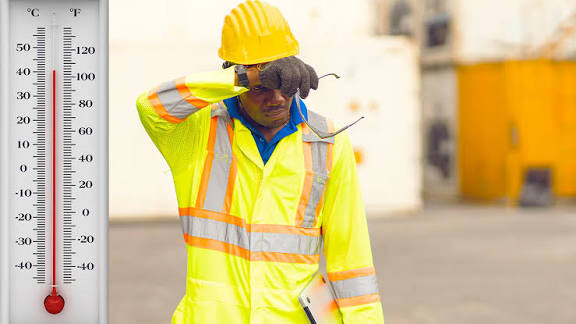
A suitable assessment should describe:
- task duration, intensity and posture;
- environmental conditions and radiant sources;
- clothing, uniform, RPE and other PPE;
- access to drinking water and recovery areas;
- work-rest pattern and overtime;
- degree of acclimatisation and recent absence;
- supervision, lone working and communication;
- foreseeable failures or emergency tasks; and
- workers who may be more vulnerable.
Individual susceptibility can vary with health, medication, pregnancy, fitness, fatigue and previous heat exposure. Employers should not ask supervisors to make clinical judgements. Obtain competent occupational-health advice where individual factors may require adjustments, while respecting confidentiality.
New starters, people returning after absence and workers transferred into hotter tasks may not be acclimatised. Introduce exposure progressively under supervision according to the actual conditions and occupational-health advice rather than adopting a universal percentage schedule from another jurisdiction.
Decide When Measurement Is Needed

Simple assessment and obvious controls may be sufficient for some workplaces. More complex environments can require measurement by someone competent to select and interpret the method.
Air temperature alone is insufficient. A heat-stress assessment may consider wet-bulb globe temperature or another recognised method, metabolic rate and clothing adjustment. Physiological monitoring may be considered in specialised circumstances when other approaches cannot adequately manage uncertainty.
Measurements should be representative of the location, time, production condition and worker. State the method and limitations. A value obtained in a shaded office cannot represent radiant work beside a furnace, and an outdoor weather forecast does not describe conditions inside protective clothing.
Define action levels and responses before collecting data. Monitoring should lead to decisions about work rate, breaks, controls or suspension—not simply create a daily number.
Avoid false precision
Conditions can vary within minutes as cloud cover, ventilation, production or access changes. Choose a monitoring frequency that can detect meaningful change and position instruments where the work occurs. Where mobile workers cross different environments, assess the sequence and cumulative demand rather than treating each location independently.
Use competent occupational hygiene and occupational-health advice when the assessment involves complex PPE, high metabolic workload, physiological monitoring or vulnerable workers. The employer should still retain clear ownership of the operational decisions.
Eliminate or Reduce the Heat Load

Apply the hierarchy of control. Ask whether the task can be automated, completed remotely or scheduled when equipment is cool. Reduce the temperature or duration of the process where practicable.
Engineering controls may include:
- insulation or shielding of radiant sources;
- separation and increased distance;
- local cooling or air movement where suitable;
- effective general or mechanical ventilation;
- cooled control cabins or recovery rooms;
- mechanised handling to reduce physical effort; and
- maintenance that prevents avoidable heat release.
Fans can improve evaporation in some environments but may be ineffective or counterproductive where air is hotter than the skin, carries contamination or disrupts LEV. Assess the complete system rather than assuming air movement always improves safety.
Adapt the Work Organisation
Schedule heavy tasks for cooler periods where possible. Provide recovery breaks based on the risk, not merely on production convenience. The recovery environment should genuinely allow cooling and should be close enough to use.
Accessible drinking water is essential, but hydration is not the only control. Encourage regular drinking and ensure arrangements are compatible with contamination controls. Avoid simplistic instructions that place responsibility on workers while leaving excessive heat load unchanged.
Limit overtime and consecutive high-exposure periods where fatigue increases risk. Use a buddy or observation system for higher-risk work. Job rotation may reduce individual exposure but can increase the number of people exposed; use it after considering more reliable controls.
Manage PPE Without Sacrificing Protection
Review whether the hazard can be reduced enough to use lighter or less restrictive PPE. Select compatible equipment with appropriate thermal properties, provide facilities for drying or replacement and allow sufficient recovery after removal.
Do not instruct workers to compromise a required seal or protective ensemble. If the task cannot be performed safely while wearing the necessary equipment, redesign or postpone the work.
Recognise Warning Signs and Escalate Early
Possible warning signs include excessive sweating, cramps, headache, dizziness, nausea, weakness, irritability, confusion, poor coordination or collapse. Symptoms do not necessarily follow a fixed progression, and a worker may be seriously affected without experiencing every earlier sign.
Training should tell workers to stop, report symptoms and seek help. Move the affected person to a cooler place and follow the site’s first-aid arrangements. Suspected heatstroke, altered consciousness, seizure or collapse requires urgent emergency medical assistance. First aiders should be trained for the foreseeable risk and should follow current clinical guidance.
Supervisors should understand that mistakes, slowed reactions or unusual behaviour may be early operational signs. Do not leave an unwell person alone or send them home without appropriate assessment.
Create a Heat-Response Plan
The plan should connect forecast and measured conditions to defined actions. Include responsibilities for reviewing conditions, communicating escalation, modifying work, checking vulnerable workers and suspending tasks.
Cover foreseeable loss of ventilation, cooling or water supply. Identify how an affected person will be reached and recovered from a roof, confined space or restricted plant area. Emergency arrangements must account for rescuers’ heat burden and PPE.
Set escalation stages that supervisors can apply. An early stage might increase observation and confirm water and recovery facilities; a higher stage may shorten exposure, defer strenuous tasks or stop specified work. State who declares each stage and how contractors and remote teams are notified.
Include arrangements for new starters and agency workers, language needs, night shifts and lone or remote work. A person should never have to choose between meeting a production target and reporting symptoms. Supervisors need authority to change the plan before a medical emergency develops.
Record significant symptoms and review whether controls failed, conditions changed or the assessment omitted a task. Update the plan following process changes, new PPE, unusual weather or occupational-health advice.
Verify the Controls in Practice
Sysco Environmental can help organisations characterise environmental conditions, workload and protective-clothing factors and build a proportionate monitoring strategy. Where individual medical fitness or health surveillance is involved, this should be coordinated with a competent occupational-health provider.
Heat stress is controlled most reliably when the organisation assesses the whole job and acts before a worker’s symptoms become the monitoring system.